
Why I Don’t Mind When My Kids Are a Little Sad/Disappointed/Upset
When my teenagers burst into tears and slam their bedroom doors, I don’t go soothe them…
It feels a little harsh to write out, but my reasoning is this: they’re learning to emotionally regulate, a key life skill. When they were younger, I soothed them, of course, but now that they’re teenagers, they’re building those muscles for themselves and getting stronger every time. I’m proud of them and believe in them.
After all, they understand that I’m here, reading on the sofa or brushing my teeth, if they need me. They know they can come to me anytime, that nothing they tell me will shock or embarrass me (“I’ve heard everything,” I regularly tell them), that nothing they could ever say or do would ever make me stop loving them. I trust that they’ll come find me if they need advice or a hug or just want someone to sit next to them and rub their back during this hard moment.
But in terms of feeling those big emotions? I would never want to take them away or prevent my kids from experiencing them. Being upset, sad, or disappointed is not a bad thing; in fact, it’s a very good thing. It’s part of life! We’re aiming for wholeness! Kids should learn how to tolerate tough emotions, run through the storm, give themselves pep talks, and realize that big feelings pass and life carries on and they’re JUST FINE.
The more they experience this sequence, over and over, the more they will learn that they can handle pretty much anything. They will be able to soothe themselves, without needing to seek constant reassurance or lean heavily on someone else or, later, maybe drink too much or punch a wall. They will be able to stand securely on their own two feet and weather whatever comes. How amazing is that? Some people go their entire lives not learning to emotionally regulate; it is a huge superpower and, I might even argue, the secret to lasting happiness?
(To clarify, I love talking about worries, struggles, problems, relationships, and life overall with my kids, when they’re calm and steadied; but I want them to learn to handle the wave of big feelings first on their own.)
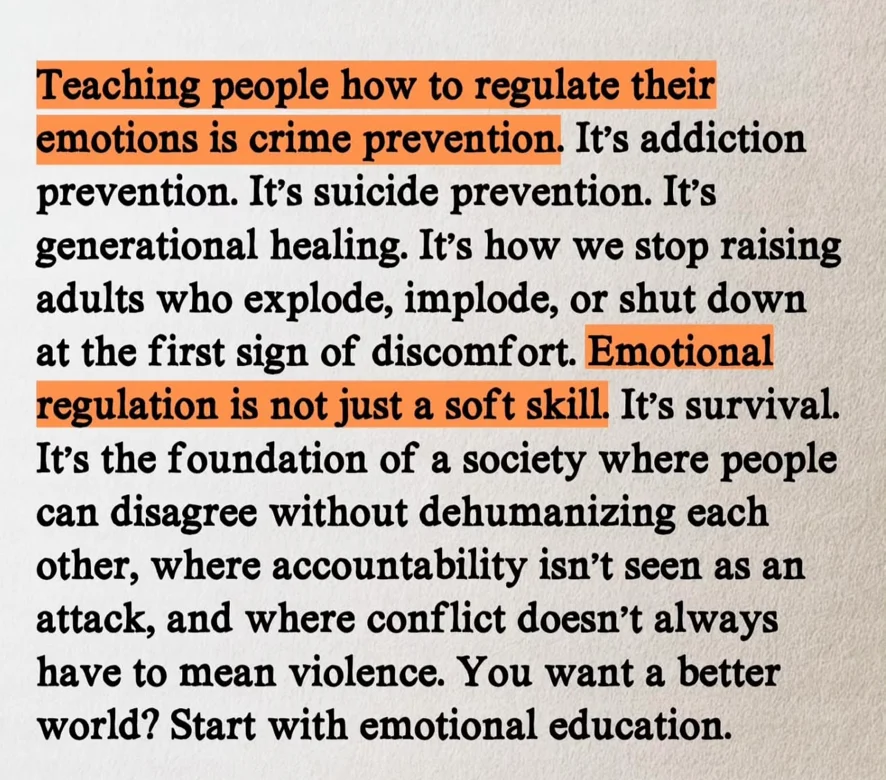
I could not agree with this more:
A few tips for emotional regulation (for all ages):
* take a break by yourself
* breathe deeply
* drink water, splash water on your face, take a shower (just add water:)
* go for a walk
* pay attention to your feelings and name them
* remind yourself that hard feelings will pass; they’re typically biggest at the beginning
* try to reframe your thinking or imagine someone else’s perspective
* consider the bigger picture (like, the Grand Canyon trick!) — your life is huge, this is one moment within it
* challenge your thoughts. ask yourself, what’s the evidence? (for example, if you think, ‘I have no friends,’ is that really true? what’s the evidence for that? is there evidence for the other side?)
* if you did make a mistake, and now you’re beating yourself up, tell yourself the phrase, “I’m learning.” (This helps me a lot when I’m frustrated with myself.) It’s okay to get things wrong, then learn and grow!
Thoughts? What else would you add to that list? I’m eager to hear how you handle and think about these moments. If my kids are upset, and I feel an urge to go solve all their problems (which is impossible anyway!), I’ll actually tell myself things like: “This is a feeling they can handle; they’re doing an amazing job building these muscles; they’re learning an essential life skill; they know you’re here if they need you; they’re going to be just fine; go, sweetie, go!!!” (And guess what I just realized, as I wrote this last paragraph? I emotionally regulate myself while they learn to emotionally regulate!)
P.S. More about talking to kids, including a scavenger hunt parenting hack and three words that changed how I parent. Plus, 21 completely subjective rules for raising teen girls and teen boys.
(Photo by Danil Nevsky/Stocksy.)
Comments
225 commentsDo you have any favorite books on raising tween/teens? Or people you look to for information?
This post resonates so much. I do the same and let my teens take their time to process their discomfort. Another takeaway I’ve learned from a past CoJ post was to see if they need me to listen or help…so when my 15 year old bounds into my room at 11pm with “Mom? It’s a listen “ I’m ready and open. These teen years feel like another training wheels moment. Except it’s not the actual bike but the metaphorical balancing and practice towards adult life.
I wish feelings had been prioritized like this growing up. Mine was much more a “Well, I damned well don’t want to act like that.” take away and turned into a near-superhuman power of rationalization. My sweet husband has done a lot of work to break through that particular mess — it sounds like you’re doing a great job.
So important on so many levels. As a former school teacher for two decades, this is what I focused on most in my classroom. I knew for the most part, academics and doing well in school will come with learning and trying, but without emotional regulation, it bleeds into everything- their school work, friendships, how they see themselves, etc. This is such a good list of what to do to regulate your emotions. I’d also add to go find an activity that you enjoy doing. While this might seem counter-productive and it might seem like you are ignoring your emotions, but it’s the opposite. You are indirectly channeling your emotions and expressing it. This is essential taking a break. Often, when you return, you have more clearly on how you feel and why and are able to move through it or even talk about it. Talking about it right from the beginning doesn’t work for everyone.
I want to thank the Cup of Jo community for hearing my worries and voicing messages of support and advice. I’m an only child and it felt like I suddenly had sisters cheering. Merci!
I’ve been thinking about this so much lately! My neurodivergent 10-year-old has been having her usual big feelings in ways that seem more like a tween/teenager and it has sometimes felt overwhelming. I’ve been taking solace and advice from the Good Inside podcast with Dr. Becky, which I highly recommend, along with collaborative problem solving. It’s not easy but kids need to know we’re steady enough not to get derailed or scared by their big feelings, especially when they’re learning how to regulate them. Would love to know any other resources people have for neurodivergent or “deep feeling” kids.
The one thing I would share, which you probably already know, is to help your child figure out what is regulating to them. Some of the traditional stuff, deep breaths, etc, don’t always work for neurodivergent people. They may need something like proprioceptive input, deep pressure, repeating verbal stims, or something even more particular to them.
Interoception curriculum!
Joanna, as a 65 yr old mother of three, I say this with great admiration and respect: you are wise beyond your years. And to your parents, mentors, and teachers- well done!
I love this post so much! So much nuance to explore in the comments, too. I’m a therapist and a tool that I teach almost all of my clients is Dr. Kristin Neff’s Self-Compassion Break practice. This practice is way to relate to ourselves during a challenging experience and in its simplest form it can look something like this: This is a moment of suffering. Suffering is a shared part of the human experience (I’m not alone!). May I be kind to myself as I navigate this suffering. She has several guided audio practices on her website that can be so helpful too: https://self-compassion.org/self-compassion-practices/#guided-practices
Alexandra, this is so helpful, thank you for sharing. One of the things I struggle with as a parent, and even with myself, is what to do with an emotion? I feel like our society is generally getting better at the idea of embracing emotions. The concept that “all feelings are okay” is actually on the cultural radar. Where I feel there is a gap is guidance on how to process an emotion. If we take anger as an example, we say it’s okay to feel angry, but then we disapprove of most outward signs of anger (outbursts, change in tone, etc.). There are many inappropriate ways to be angry, and I think most people could list them. But appropriate ways to express anger? I don’t think much guidance is offered in this regard. I’ve done a lot of introspection, meditation, prayer, listening/reading from experts, but I think it would be game changing if the “how” of processing an emotion were discussed more openly. I don’t only need to know the names of tools, I need to know how to actually use them. I’m so grateful to people like Kristin Neff and yourself who shed light on operationalizing this.
Hi Cindy! I’m no therapist, but I have been in therapy a while. Anger usually presents in my body as a really intense, kinetic thing and I need that exact behavior to get it out – I’ll jump, shout (if in an appropriate place like my home or car), punch the air, shake, and say things like “I’M MAD RIGHT NOW!!” Somatic processing of emotions is one of our greatest tools!
As a public school teacher, I will tell you the introduction of SEL (social and emotional learning) has been so rewarding not just for my students but for my colleagues as well. Unfortunately the right has targeted it as their next boogeyman.
As a parent of a Chicago Public School kindergartener I agree with this 100%!!
Could not love this post more. Pretty sure emotional regulation is the key to just about everything; it’s certainly a large piece of the parenting pie!
I’m on my first big work trip without my baby. My husband just sent me a video of our one year old going through this whole complex set of facial expressions, and my husband is gently narrating, “Do you want to tell Mom about how you were feeling sad, but you’re happy now, and all those feelings are okay to feel?” Here’s where the metaphorical tv camera cuts to me, sobbing into my phone at the big group dinner.
I love this. I’m crying too !
Any recommendations for a good kids book on emotional regulation?
We’ve been enjoying books from A Little SPOT series (Diane Alber). I’ve got a 4.5 and 6 year old.
The Bright Big Feelings books!
My son received “A Little Emotional” from the Dolly Parton library program and we pull it out a lot when big feelings are happening!
The Color Monster is wonderful!!!
The Grand Hotel of Feelings is wonderful!!! The hotel manager makes room for ALL the feelings and knows they all need different things.
Thanks for this post, Joanna. As others have mentioned (and as you have responded to), emotional dysregulation and neurodivergence is a challenging topic for many of us, including myself/my family. When I hear the term “emotional regulation,” I often have a knee jerk reaction because parenting a neurodivergent kiddo has been one of the most challenging (and rewarding) experiences of my life. As a “neurotypical” person who has nonetheless experienced a fair amount of trauma, it has been quite the learning experience to parent an incredibly gifted Au/ADHD kiddo alongside his Au/ADHD dad. I would love to see this angle of parenting and being brought up via Cup of Jo, where it makes sense. Reading the comment section and seeing how many other readers are in a similar boat gave me an insane amount of comfort. Not that I’m surprised, the CoJ community pleasantly surprises me on a regular basis.
This is SO good to remember. My oldest daughter is really upset about missing a Halloween party that all her friends are going to. But it’s an alcohol-party at someone’s house who I don’t know (child or parents) so I am not letting her. (American in the UK so think this is a big culture-clash moment for me). I hate how sad she is and how left out she’s feeling and I’m persona non grata around here. But these feelings ARE a part of being human and it’s not bad to learn how to weather them.
Oh, Kate–yup. My sons are grown, but I went through this with both of them. And 1. several parents over the years have told me that my stance helped *them* make healthy decisions (!!!) and 2. my own boys have mentioned how they remember the clarity of our household rules and the benefits of the clear boundaries (after, of course, the sulks and “No one else’s parents. . . ” arguments).
I love this conversation! I just want to add that I have 3 kids, and they all have or had wildly different needs and struggles when experiencing that first big wave of emotions. I’m sure there are parents out there reading this and thinking, “That does not work for us.” So much parenting advice is exactly what one kid needs, but not another, and if you know this doesn’t work for your specific teen, it’s really okay to adjust. Also, this advice might work when your kid is 15, but they might need something else when they’re 17. It might work on a teen who is able use healthy strategies to calm themselves, but not on one who finds other less healthy ways to self soothe. This is great advice that I know many people can benefit from, but if it’s not right for your kid, you do you!
I’ve been thinking about this a lot lately after watching A Swim Lesson (directed by Rashida Jones…mentioned on her episode of Good Hang) — the ability of humans…and children in particular…to overcome barriers, emotionally regulate, engage with challenge is beautifully told in this 25-minute documentary. I’ve been recommending it to everyone! We are all capable of so much more than we sometimes think we are. We’re resilient!
oooh can’t wait to watch! thank you, Kirstin!
A big unlock for me was understanding that EVERYONE goes through moments when they have the whole body sobs – everyone including the pretty girl, the athlete, the always has their shit together person, everyone. One day for some reason a group of us highly accomplished women were going through our coping mechanisms and mine was sobbing into a pillow at night because the pillow soaked up my tears. Another person was crying in the shower to wash away the tears. And somehow it was so funny that we grown up people still sob uncontrollably to comfort ourselves and it was a deep moment of connection for me. Since then, I have not sobbed uncontrollably about stupid stuff at work, though I do for other reasons and I remember that everyone does it and I am comforted that it’s a normal coping response.
It’s actually so good for you! My therapist told me that tears contain cortisol!
I grew up in a family of neglect and abuse. I wasn’t taught how to regulate my emotions. I walked on pins and needles and shaped my life at home around making sure everyone around me was happy- or at least- not angry. That, and other things led to a life of misery. I didn’t realize how depressed I was, basically all my life. At 31 I finally started seeing a therapist regularly. She taught me a lot of things but learning how to regulate my emotions is probably the second biggest lesson I learned from her. (The first being that It’s not my fault and I didn’t deserve it.) I’m happy to report that 11 years later, my kids are so emotionally mature compared to me that it literally brings tears to my eyes. I’m really proud of me. I do have a hard time with letting the kids be alone if we’re disagreeing. I think it’s hard for me to leave them alone at those moments because I was alone with my feelings so much. However, I am getting better at that, too.
oh my gosh, Kim!!!! this is incredible. wow, what you have survived and built.
I just love that you have created this for your children. Both my parents grew up in unstable and abusive families, mostly through what life dealt them (war, and the ways people recover from that ) but without ever experiencing a loving and supportive family they gave that to my brother and I. You are amazing! One day your kids will be adults and they will suddenly realise you were their hero all the way.
Hi Kim, thank you for sharing. My child experienced abuse and neglect for the first five years of life and so much of our parenting is focused on learning to regulate emotions and feel secure attachment. Honestly, it is really helpful to hear your story while we are in the thick of this. I couldn’t hope for a better outcome in our future. Thanks ❤️
Thank you all for your kind words. I couldn’t have healed without the privilege of health insurance and my husband who literally took the reins of taking care of everyone else and begged me to go to therapy. Love this site, Joanna. Often it feels like the only safe place online!
How does Cup of Jo so often know what I need when I need it? My 12 yo Au/ADHD child is doing so much hard work with emotional regulation. Because of his neurodivergence I need to step in at times for the safety of our household, but am trying to practice leaving space for it all. Thank you, Jo.
Bridget, mama solidarity. The topic of emotional regulation is an evergreen topic in my neurospicy household. I am practicing the same. <3
This brought up a lot of feelings for me – I keep returning to the point that I don’t want my kids to isolate behind closed doors when they are having “unattractive” feelings. I am so relieved when they come to me and say, “Can I talk to you?” And share something with me that they aren’t sure how to cope with. In terms of calming down, have taught them strategies, but the teen and tween brain is such that they may not be able to access those strategies in times when they are dysregulated. I always go back to, what do I want this to look like for them when they are adults and in their own relationships – and try to go backwards from there.
I hear you! to clarify, when they were younger, I held them and soothed them and validating them and walked them through emotional regulation tools for about age birth to 10; and now that they’re older, I’m slowing stepping back and giving them more space to try these tools on their own. they seem to want the autonomy (by leaving the room, taking breaks, etc.), and I don’t want to interrupt that process by following them and going into their rooms or trying to solve problems instead of letting them navigate through all their feelings. but if, during that process, they come find me, I’m so happy to hold them or sit with them while they feel those feelings; I’m always here for them — not to solve problems, but to witness them. and then when they’re ready to talk something through, I LOVE discussing big and small problems with them, as a sounding board; that’s one of my favorite parts of parenting. hope this makes sense, anonymous! thank you for writing xoxo
@Anonymous, I think the difference is being there for them when they come to you vs. following them/chasing them down when they want to be upset and alone. Sometimes teens really don’t want interference. Advice, support, hugs etc. are not always wanted by them. And then I think the respectful thing to do is not to interfere with their process; otherwise, they can feel smothered. When they come to you wanting advice, support etc., of course it’s important to be there for whatever they need.
EFT tapping (emotional freedom technique) was HUGE for me for emotional regulation. Especially Brad Yates on YouTube (my friend calls him “Tap Daddy,” lol)
Love this so much! When I see my close friends parent, I’ll notice how they acknowledge their little kids’ feelings (rather than try to shut them down), help them identify what they’re feeling, and help soothe them. It’s so beautiful. I had to learn how to identify, process, regulate, etc. my feelings in therapy throughout my 30s because my parents didn’t have these skills and couldn’t teach me as I was growing up. I’m so grateful for therapy and learning emotional regulation. It got me out of an abusive marriage, helped me through a difficult mid-career shift, made me a better friend and romantic partner, and gave me the tools I needed to build the life I wanted.
To me it feels right to acknowledge the big feelings and then give them space. I grew up with parents that ignored me whenever I was upset and I think I learned my feelings didn’t matter.
I love this post and the thoughtful conversation it’s started about emotional regulation. One thing I see missing from the comments is neurodivergence, especially how it plays a role in regulation. My child was very dysregulated in early elementary – talking about calm breathing did nothing. Eventually a full neuropsych eval confirmed adhd, anxiety, highly gifted…all things we could officially learn how to support. So I want to add that consideration for anyone struggling with kids’ emotions (or, heck, spouses that may not have been dx as a kid and therefore struggle with regulating in front of kids, or the issue that many girls aren’t dx until tween/teen years). Not that everyone should rush out and eval their kids, but I’ve noticed that the attention on Deeply Feeling Kids may not go far enough to call out there’s deep feelings, and then there’s ND, a diagnoseable medical condition.
Yes, was thinking the same when reading this. My ADHD daughter’s emotional dysregulation is a huge feature in our family’s life, and she will scream at you if you try to introduce any calm down methodologies into the equation. It’s like my encouraging her to breathe is an insult, or like I’m taking something away from her that she wants. Maybe anxiety is such a strong feeling that it’s attractive to the neurodivergent brain in the way that calm just isn’t. Anyway, I did need to read this today. My son last night – not quite a teen, but close! – had a meltdown because I wouldn’t buy him an expensive new computer. This meltdown included lamenting how poor we are, how his friends all have nicer houses and cars than we do, etc. When my kids say bratty and outrageous things like this it’s hard for me to just go let them steam in their rooms. It’s hard not to push back or try to moralize about “keeping up with the Joneses” – but it’s true that it’s not the right moment for learning.
we actually have a kid who is neurodivergent, and our experience at early ages was that he needed a LOT of scaffolding and help navigating big big feelings that lasted a really long time. now at an older age he has learned how to take a break and calm himself down before talking through the issue, but it’s still a work in progress of course. I’m sorry to not have talked more about neurodivergence here; I try to keep things pretty private, but then it can seem like a discussion lacks that side of things, I realize. thank you so much for your thoughts and notes!
100% on this – one of my children was hospitalized for a mental health condition (and also has epilepsy, some sort of unusual executive function disorder, and is gifted). We had to do an intensive outpatient program and one of the main things they taught us was that the typical parenting strategies don’t really work with kids with intense behavior or mental health issues. They DO work for most kids, but for kids who are neurodivergent, have more intense mental health issues, etc., there are a whole bunch of parenting techniques you need to try that no one is ever taught, and some of them are actually the opposite of typical parenting advice.
Very similar for raising kids with early childhood trauma. I think parents in the foster and adoption community share a lot with parents of ND kids. Plenty is different of course, but many behaviors and challenges in common
I love that this comment section has opened up a conversation about neurodivergence and emotional regulation. My 7 year old was recently diagnosed with ADHD, autism, and identified as gifted. It can feel very lonely… to put it lightly. I so appreciate your comment Joanna.
Thank you, Mary. My kid has ADHD (as does my husband), so emotional regulation is a particularly salient topic for me. Having the diagnosis and seeking out support has made a night and day difference.
Hi all: gifted plus ADHD/autism is called “twice exceptional” or 2e. It really helps as a search term when you’re looking for resources, and took me much to long to come across it. <3
Anon – I’m there with you on feeling alone. We didn’t add ASD for a few years when things still weren’t adding up; I’m glad you got that clarity sooner. The gifted part feels isolating since our child didn’t seem to “need” academic supports but it was so useful when we figured them out. And I’m grateful for Jo to highlight ND as well.
Thanks Mary. We actually had long, confusing year between his ADHD and autism diagnoses as well. And yes, doesn’t the giftedness/masking at school make it even that much more complicated!? We are definitely still in the thick of it all, and haven’t found anything that really helps him yet, but these comments give me some hope that maybe one day we will..
I am loving these comments and would appreciate any insight for my own family. My oldest child (10) relies on thumb sucking as a primary means of emotional regulation, coping, etc. They came out of the womb with the habit, and it stuck, and we didn’t do much to discourage it early on, and… here we are. We have supported them through a year+ of OT (and months of counseling), to learn additional coping skills AND to try and address the underlying reasons for it, and… nada. They loved OT, but can clearly articulate that they don’t *want* to stop. I’m coming around to this idea of using the thumb at certain times at home, sleeping, etc but struggle knowing it is happening at school (I’ve witnessed it), with friends, in public. My child sucks their thumb for comfort, but also as a general reflex when bored, reading a book, riding in the car, or just walking around the house. I am internalizing the idea that I cannot make them stop, nor do I want to ‘rip away’ this important coping strategy. AND. I can also admit that I don’t want them to be made fun of at school (5th grade), the germ contact makes me shudder, and generally society doesn’t view this nicely or as a thing for mature people to do. And we live in society, so I won’t discount that stuff. To be clear: I do NOT shame them for this at home, we offer lots of redirection and resources for distraction/stimulation, and it’s very much a “you are perfect as you are, and this maybe isn’t great for your physical health” (teeth visibly changed, germs on thumb into mouth bc no one is handwashing that often). Solidarity or kind suggestions would be appreciated. I’m sure they’ll grow out of it eventually (at least in some ways), but it’s also a daily thing to witness, remind, keep the skin of the thumb healthy/not cracked due to dryness.
My daughter had a thumb sucking habit also-a bit different in that she did it while relaxing and falling asleep. Because of the 10 years of thumb sucking, she needed a palate expander. This was the only way she was going to stop sucking her thumb. I was prepared for hell since she wouldn’t have her soothing mechanism, but honestly, it was a couple of weeks of complaining and she adjusted. You have already done lots of work on helping them to learn other coping skills that its just now a process of breaking the habit-which they won’t likely do on their own.
Former thumb sucker here! I didn’t go until 5th grade, but it did go into some point of elementary school. I also had a blanket I would dig my thumb into to make holes with, and that often was a substitute (at home, I did not carry it around Linus-style). It was the thumb callous that started to gross me out and hurt as I got older. There were two other thumb suckers in my grade—one was made fun of a lot (that really scared me and reminded me to keep thumb sucking at home), and the other had a fake toy thumb they kept in their pocket and used as needed. It helped that we had a lot of nail-biters, whose moms must have all been talking, because they all had fake thumbs they used to tame the nail biting. I later went through very intense orthodontics in my teen years and rued my thumb sucking that led to it. I wish I had helpful advice, but you are doing great!! You sound supportive and loving, the most important thing your child needs.
I sucked my thumb until I was 12, but only at home, as I knew I’d be made fun of at school. I knew I did it because it was soothing (I had a ratty ball of yarn that was my “blankie” too… I still have it!) but I never made the connection to the experience of having a mentally ill mother until recently (I’m in my 50s). I only quit sucking my thumb because my mom told me that if I didn’t stop I was going to look like a person we saw in public who had a facial deformity. I doused my thumb in tabasco sauce in order to stop, and it worked. What I would like people to know about thumb sucking though is this. I had to have corrective jaw surgery, both upper and lower jaws, my mouth wired shut (I don’t think they do it this way anymore though) for 9 weeks when I was 16 because of the large overbite it caused. Now, in my 50s, I just discovered that I have degeneration of the condyles of my jaw and will never be able to open my mouth all the way again (I can laugh at myself that I have to kind of push food into my mouth to make it fit, lol, but I worry how this will progress over the next twenty years). Anyway, the truly soul comforting method of thumb sucking that helped me cope has had some serious and lifelong physical effects that couldn’t really be anticipated back then. It’s hard not to wish someone had provided me with an alternative and I hadn’t screwed my mouth up so much. Some food for thought.
I sucked my middle and pointer fingers until 7th grade. Only at home when watching tv or sleeping but as soon as I had to get a pallet expander – they wouldn’t fit anymore ! Had no choice but to give it up once orthodontia hit. Are braces in their future ? That could unintentionally put an end to things …
Counterpoint – I sucked my thumb until I was 12 (my family moved when I was 10 and I needed it as a coping mechanism). I trained myself out of it when “awake all night” slumber parties became a thing. I did not need orthodontia or have skin problems or get sick more often than other kids. I have not relied on it since then. I have a daughter who is 13 and still sucks her thumb to fall asleep. She also has orthdontia-free teeth and no other side effects. Sometimes its just a coping mechanism that you outgrow!
My mom bought a foul tasting thing from the pharmacy that was designed to prevent nail biting, and painted that onto my thumb. I don’t exactly remember how long it took to break the habit, but the fact that my mom meant business “we need to do this now” and wasn’t going to relent made me accept it. And the foul tasting thumb also helped, especially automatic behaviour, like during sleep.
I find it interesting that there is a subtle tension in the comments on when people/kids can start to manage anything on their own and fears that people/kids can’t handle x, so parents should still manage x. I see x as so many things my friends discuss re; their kids–paying for a car, managing relationships, getting a job, finding an apartment. At some point, people/kids need to take this work on themselves.
This tension is REAL! The stakes seem high, right? Especially as kids get older. A recent episode of Dr. Becky’s podcast really put this in perspective for me. She was talking about sharing, but offered this insight: In any relationship, there are only 100% of any emotion or feeling, so when any part in the relationship takes on too much of the feeling or emotion, there isn’t enough left for the other person. Her example was sharing. If you have a kid who shares well (100% of the sharing) and one who doesn’t (0% of the sharing). You need to encourage the sharer to share less. I think this also applies to parenting. If you are doing 100% of the legwork or the mental load, or the managing, you aren’t leaving any percentage for the child. My mom was very “cheer-up, buttercup and look-on-the-brightside” about everything, and that left me 0% in the optimism department, and as a teen and tween, I badly needed to claim my own optimism. I think this extends to EVERYTHING. You can’t be 100% of the validation, the problem solver, the critic, the healer/fixer, the crank, the fun-maker, the apartment finder, etc. or it leaves nothing for the kid. This perspective shift has been very useful for me!
I agree for the most part. It’s important for parents to recognize concerning patterns/ behaviors and get their kids help, if needed. Let them figure things out, but being aware if things are starting to spiral. It’s still our obligation to be there if things are heading into concerning territory (sadness that heads into true depression, toxic relationships, etc)
A lot of the comments here have also mentioned loved ones who have lost their lives through suicide or they are frightened that someone might take their own lives. My sister works for Suicide Prevention in Scotland and just recently it was Suicide Prevention week so she wrote this poem. I hope its ok to share here but it gives little tips on what to do if you think someone you know is in that place. Sending so much love to everyone who has ever lost someone to suicide. xxxx Suicide is a subject That for some is still taboo. In Scotland the daily death count Is still averaging at two We can all play our part Each and every day By simply asking someone “Can I check, are you OK?” A simple smile at someone Who’s walking down the street Can change their state of mind And make them pause to take a seat If you are really worried though You need to ask them straight “Are you thinking about suicide?” For their answer, please do wait You won’t put the idea in their head Research shows that’s not true So please don’t think that their thoughts Are cause of things said by you If you ask and the answer is yes, Please listen if you can If at all possible get them to come up with What we call a “safety plan” A safety plan is simple It’s unique and personal to them They write down what they can do If these thoughts intrude again! It will be a list of people That they know to trust and turn to It also might have different things That are practical for them to set to. If they say yes and you can’t keep them safe Risk to life trumps all You should always seek support Even if they say no, please still call. Suicide prevention week Gets everyone talking about it But every day can be prevention day If we just make a pledge to be kind, and stick to it. Credit to my sister Catherine Anderson
Your sister, Catherine, is a hero and angel on earth. Thank you for sharing Aileen.
Thank you Aileen for sharing this beautiful poem and the very important message it carries. Thank you Catherine Anderson for spreading the word. Unfortunately I’ve had to ask that question, and I’d like to reassure people who might need to in future, that it’s actually not as hard as you might think. Somehow, getting an answer, even when it’s not what you want to hear, can help. It gives you a starting point, a place to take action from. You feel slightly less helpless and the person you’re asking feels slightly less terrified.
Thank you for sharing this. I was disheartened to see that teaching emotional regulation is “suicide prevention.” The majority of people who die by suicide are suffering from a clinical level mental illness or challenge, and it doesn’t have anything to do with not being taught regulation. Can we please not add to the idea that those who die by suicide just weren’t mentally “strong” enough?
I love this so much Aileen, thank you! And thank you to your sister for writing and sharing this. Cait, I think there is a confusion. No one here is saying that “those who die by suicide just weren’t mentally “strong” enough”. And yes, teaching émotionnel régulation prevents suicide by helping people to feel better in their lives, even the ones with clinical illnesses (that can become less strong if émotionnel regulation is learned, and if the closed ones learn it too). And also it teaches people that IT’S OK to ask for help, that speaking about your challenges, your difficult emotions and showing your vulnerability is a real strength. So much people who commit suicide kept all their suffering for themselves and don’t see how many hands would have turned to them if they had shared their struggles. (And I unfortunately went through that as I lost a closed one this way).
Jo, this post made my heart ache. I am learning these skills now as a 36-year-old with complex trauma. Unfortunately a chaotic home and parents who didn’t have a good emotional skillset meant I just stuffed everything down or ended up turning to really unsafe people to soothe me, and eventually this made me really really sick. Reading this post was sort of like getting the parent advice I never got! I am bookmarking it and will return to it when I am feeling in need of a little mothering in hard moments. Thank you <3
This is helpful. Instagram is so saturated with pop psychology telling everyone to sit in their child’s bedroom and co-regulate. I can’t co-regulate when someone is screaming/crying loudly in my ear and dysregulating me simultaneously! It truly has paid off for my children and me to listen to my gut and let them know I’m nearby and we can chat in a few minutes after we are both calm. I’ll even fold laundry in the hall next to their rooms (which also is a grounding activity for me).
I hear you on this. Me sitting in the room ‘calmly’ seems to make my kid blow up more (and increases the odds of me losing it)! The struggle is real. And trying to figure this stuff out with all the ‘pro-tips’ circulating is even harder!
@Jacqueline, To me, sitting in their room and co-regulating would be suffocating them. I think it’s disrespectful to your child to insist upon being there when they want to be alone and upset! Sometimes people need to be alone to calm down and feel better!
Throughout this whole piece, I found myself thinking *clapping hands emoji,* yes, yes. And this is coming from someone who struggles with this soft skill, myself. Progress, not perfection, right?
I am learning so much from posts like this one. I feel that I don’t even need to buy a book about parenting anymore ;-). You do have an incredible community, Joanna, with truly amazing insights and advice or is it that in the US you are also far ahead about children development than in Europe (at least in France). I lived for 7 years in NY and when my kid started school I was blown away by how the teachers were talking to the children. The way they were warmly welcomed every morning. The fact that there was a self regulation corner with a basket in the class filled with soft toys, sensory rain makers…, a poster with all the feelings represented by different faces and so many other things. Also seeing parents dealing with tantrums in parks with soft voices. It completely changed my way of parenting !
All of this! I’m a parent to two young adults, and teach middle school…EVERYONE needs to know how to manage challenging times, and I can’t tell you the number of parents I’ve dealt with over my career who are snow plow parents…they push all problems, struggles, challenges out of the way for their kids…and end up with a human being that has no ability to self manage, since they’ve learned it is never their fault and that someone else will clean up the mess. It’s sad. Of course as a parent, it is hard to see your kid struggle, but the struggle is part of what helps one become a functioning adult!
Amen!
How do we make sure they’re not just burying themselves in screens, instead of actually working through the emotions in a productive way? No screens in bedrooms?
Yes, that should be a base rule always. It’s hard today’s climate, but I teach high school and the number of kids who tell me they’re going down internet rabbit holes until the wee hours is unreal.
Hi Kay, maybe a different angle as I am currently introducing some life guidelines myself, that could be of use for any age: internet connected device only at kitchen table (where other humans walk by etc.) to keep it short and when not eating. Not on the sofa, definitely not in the bedroom. I can have a call with another human. But no social media, no google (I want to teach my brain to not google everything, it gets boring). And because I need to go back to the kitchen table every time a „let’s google that“ / „Uh I had a thought I don’t like so let’s dive into insta instead and drown myself in there and not live my life“ crosses my brain, I stop myself because „oh my, what am I doing with my life?“ Podcasts only when walking (also in rainy weather) because I tend to spend more time with podcasts (not all great quality) than with people or just in silence (to hear my own thoughts). Also: regular weekly get out of the house events with other people (sport, choir, volunteering). No excuses. I need to relearn that people are better than the internet. I started with all of that 7 weeks ago. Expanding the standard circle of connections, including talking about life and feelings. I feel a bit like 1992. I like it. And I think others might like it, too.
I would love more conversation about how this works. In principle, I am in favor of no screens in bedrooms. In practice, my kid listens to podcasts and audiobooks while brushing teeth, and as a solo activity and I really don’t want to take that away. Which means… he’s doing it on a screen. Any tips????
Charlotte, I will adopt your principles! Thank you!
This comment is for Mado: Two ideas to have no screens, but do have podcasts and audiobooks: 1. Set up screentime controls on their device that you set; all other apps except podcast and audiobooks are unusable between certain hours, e.g. 8pm-8am 2. If you have an old iPhone laying around, you can erase all the apps on it except the podcast and audiobook apps. (You make yourself the owner of the phone, or it can be with the child’s account, but you set it up to require any apps added App Store requires a password.). This phone doesn’t need cellular data, it can just be a wifi connected device and you can download podcasts and audiobooks on it. Think of it as an upgraded iPod.
Mado, we have a Yoto player that my kids use for audiobooks. They keep it in their room but you could easily move it around. We love it because they can independently listen to books and podcasts, but it’s not a screen/internet access. Worth checking out!
May be time to bring back the CD player. You can borrow books on CD and music from the library!
I am a 40 year old reader with a 67 year old mom who, last year when I told her I was queer, told me how sad she was for me and that “this decision will only lead to pain and sadness.” The irony is that the only thing about being queer that’s caused me pain and sadness was her response. The rest has been pure joy and revelation. When I see the notes and comments about all of the moms here who are promising to love their children no matter what and that there’s nothing their child could tell them that would stop them from loving them, I feel inspired (and envious). Isn’t what we all want just love…without conditions?
Dear Ruby, sending you a big hug. You’re seen. <3
Ruby, I’m just a stranger on the internet and I’m not a mom but I just wanted to say I’m SO HAPPY FOR YOU for your queerness and your joy.
Your mom grew up at a time that being queer causes pain and sadness, she expressed her fears to you. This does not necessarily mean she rejected you or she stopped loving you.
Congratulations, Ruby! I definitely feel like the queer identity and community is the opposite of what your Mum thinks it is. She’s only 67 – mine’s quite a bit older – so I’m thinking that, with time, seeing you grow into the person you were meant to be will clear up her wrong impressions. In the meantime, I wish I could share mine with you. She wouldn’t care who you’re bringing over for a visit, as long as they’re down for tea and Golden Girls reruns.
Much love to you, Ruby, without condition.
I think I failed at this. My first daughter suffered from anorexia for years and she’s 27 now and still reaching out every time she has a difficulty. We were so afraid she’d commit suicide during those years that we were very close by and tried every possible way to relieve her suffering. I realize now that itwas a mistake, but where do I start? I’m burned out myself as a result of being always there for her (and my suicidal mom, but that’s another story). Merci!
I don’t have a suggestion just wanted to say it sounds like you are a really good mom. You can see how much you love your daughter from those few sentences <3
Annie! You helped your daughter survive through her suffering. You all— you and your daughter— have been so brave. And perhaps now, as a family, you work towards some new patterns. I am 34, my sister is 30, and my parents and us all did family therapy to start to develop new patterns and let go of ones that no longer support us. All families need to make changes as life changes. You have not failed! Your just ready for something new.
Hi annie, I can’t recommend the book “codependent no more” from Melodi Beatty enough for situations like this. It really helped me find my way with a relative who had needed me a lot for a while but then never learnt to stand on their own feet – or I didn’t let them?
Sounds like you are an loving mom who has a daily who think you are her safe space. I think it is really important to not rush to solve a problem so all the suggestions here are great, but also feeling like someone is there for you is amazing. Not everyone’s kids are the same my younger son struggles with anxiety so he went through a phase of needing me to be with him as he went to bed-at first I was eager to wnd it have him try to learn to self regulate but his therapist actually suggested that I sit with him, have a little chat and then not soothe him but just he there (I put in earbuds and listened to a book) she said he wouldn’t want that forever and now he is 14 and doesn’t need that anymore Maybe when your daughter come over you can just sit with her in her discomfort and let her try to figure out what to do in her own whole she has your comforting presence But Im not a therapist so also a therapist for you or her or both of you might also help
I agree with the previous poster who said to read that Codependent No More book. The first thing I thought when I read your post is that you sound like you’re dealing with being codependent. It will drive you insane. Please look into that book or just learn more abt codependency and what to do abt it.
I don’t know the specifics of your story, but it sounds like you’re blaming yourself for …doing your best. Knock it off!! You are a good mom b/c you care and you acted out of love! You did your best then and you’ll keep doing your best now, even if what your best looks like changes as you get more information (mostly from experience, not blog posts) and your kid grows.
As a mother, especially when you are worried about suicidal, it is too much to ask that you also figure out how to prevent codependence. Now that she is older and you hopefully feel safer, you can pursue whatever you think is best everyone – but I hope you won’t shame yourself or feel badly for your protectiveness, which in all likelihood saved her life. So much love to you ❤️
I’m eternally grateful for the movie Inside Out, both 1 and 2. It gave words and conceptual understanding to my 6 year old about her feelings. Now when she feels sad or angry, she knows it’s an emotion pressing her button and that it is there for a reason. Her job is to then figure out why. She also tells me she just has to wait a while before Joy takes over the button. That said, she also knows to use this to her advantage: When she’s pushing the limits of my patience, she will ask “Mama, where is your Anger now?” And I’ll reply “Sitting very close to the button” or “My Anger’s finger is on the button”. This tickles her and she’ll “help me” by taking a step back. This helps me with my emotional regulation too because I just can’t get angry or impatient!!
I love this! What a great framework to teach to young elementary aged kids.
Joanna, thank you for this informative post. It’s just what I needed as a teacher for my students as well as for myself.
Completely agree – such a great post! ❤️
The subject line here made me not want to look. Just 6 months ago I visited friends who were having a true nightmare with all things their 13yo daughter. Self-hate. Depression. Anxiety. ED. Maybe more. They asked me—how is your daughter doing ok. And I TBH I believe i smugly thought that I was somehow doing more tricks and self awareness and openness and her, we just have this amazing communication. We she gets upset i let her know boundaries but that Im always here for her. Cut to 6months later and all those times i let her slam her door to cry and work out her emotions. It was her school who saw that she was SH. cried hysterically in the call. And the bottom has dropped out of my life since then. Therapy is now weekly and I never leave her alone for long. Doors are open I can’t believe how different life was 6 months ago.
Thinking of you and your daughter during this hard time.
Sending you internet hugs! This is so so hard.
I’m sorry this is such a rough time for you and your daughter (and your friends and their child too). I’m just a random lady in the comments section but wanted to say you sound like a thoughtful and caring parent, and I hope that six months from now you still be in a much better space after making it through this storm.
Thinking of you and your daughter! Sending love.
With you deeply on this. Parenting is so complicated and difficult. Especially when we’re recovering from our own trauma and navigating mental health, while also supporting our children through theirs. Hugs of solidarity to all.
I coach ultimate Frisbee to elementary schoolers at Title I schools a couple of afternoons each week. I’m young-ish (24) and don’t have a lot of kids in my life outside of work so maybe don’t have the best point of reference, but I’ve been repeatedly struck by how many (older! 10/11 year old) kids lack any sort of emotional resilience. Many of them are sent into a tailspin by small bumps in the road, like getting out in a game of frisbee tag or being on the losing team in a game (and I am very careful to deemphasize winning as the point of a game, although I do think that competition is healthy and worthwhile). Their lack of ability to self-regulate will derail the session for the dozen+ other kids. Obviously emotions and emotional regulation are complex and nuanced and come from all sorts of sources. But I guess my point is that while kids should be able to feel their feelings, there’s also value in telling them to buck up—part of emotional regulation is being able to deal with an emotion internally and privately, and not letting your emotions become EVERYONE else’s problem. And learning to do that is actually a deeply empowering process for them. I generally really like my coaching work and am surprised every day at the maturity and sweetness and drive of these kids. But sometimes… whew….
Interesting! My kid – who is 16 – says the same thing about the 9-11 year old cohort. She works at summer day camps and sees it very starkly. Her theory is that it’s a pandemic effect. That these kids lost the emotional regulation they would have got at a formative time starting school and surrounded my peers. This emotional growth was not only delayed, but replaced by lots of screen time, busy stressed parents, and heightened cultural anxiety. Has anyone else noticed the same thing?
You sound like an awesome coach! Keep up the good work! You are helping those kids build their emotional resilience.
Well said, Sara–letting kids feel their feelings AND teaching them that there are times to put those feelings aside for a little while to accomplish something or get perspective: I would say those concepts are not opposites, but two parts of a vital whole. Both are necessary for true health and balance.
A friend lead a hiking group of college students for a fortnight in Spain and came away saying that they had the maturity level of high schoolers.
I don’t think it’s the pandemic at all. I am convinced that parents now do not let their child fail or experience any sort of difficulty, so when that happens they cannot cope. Life is going to be a bumpy ride for them. I may take fire for this take, but I stand by it.
This doesn’t surprise me one bit! I was a manager for a popular clothing retailer that employed a lot of young adults (I think our median employee age was 20) and I was astonished at how many parents of adult children would chime in and try to “do” their uncomfortable conversations for them. I’ve had parents try to quit on their children’s behalf, attempt to call in sick for them, berate me for performance managing them over obvious issues, etc. One Christmas a girl tried to bring a puppy in for her shift (cute, but not the time, and not without asking first please!) and when I told her she needed to find somewhere else for her dog to go, she replied “but… MY MOM SAID I COULD!” Thanks Jo for encouraging the masses through your share to see their children’s capability and allow them to explore it individually. I believe thoughtful approaches will yield 20 year olds who have the fortitude to live their lives on their own terms, come what may.
Sara, it sounds like you’re a thoughtful coach and I’m sure the kids are grateful for you. I teach at a Title 1 behavioral alternative school (meaning my kids get kicked out of their assigned schools and sent to us for a time). I think it’s important to dig into the ways that systemic and generational poverty overwhelms the nervous system. Not to mention, parents that were never taught how to regulate and are now working multiple jobs, facing food insecurity, etc. don’t have the bandwidth to stop and evaluate patterns and break cycles. With that being said, my school staff spent an entire year doing trauma-informed care training and mental health first aid. We actively work on mindfulness and emotional regulation with our kids and it really works. Sometimes they just need someone to teach them some different ways to cope. And you can’t teach them while they’re escalated. You can’t learn during stress. Work on a new technique during practice or before games (even just mindful breathing and being aware of how your body feels in certain emotional states). Thanks for all the work you’re putting in. Great coaches have such an impact.
A family counselor told me that it’s good to share feelings with your kids, especially for me as someone who presents and prides herself as “fine” a vast majority of the time. We have a more emotive and big feelings pre teen boy, and her comment was that it could be hard for him that he’s feeling all these big things when everyone else in his family looks like they’re always calm and fine, which of course we’re not but I in particular can gloss over and suck it up. So I’ve been trying to be more expressive and emotive, good and bad. Sigh, parenting is so hard.
That is eye opening to me, A. Thank you for sharing. I actually remember, after our divorced, one of my kids asked me, why are we all sad but you are happy? And I was surprised because of course I was sad too, but I had been trying to hide it from them and be a rock for them. I realized that it might have been helpful for me to share more of my feelings. Thank you for sharing this!
I think this is one of the most vital qualities as a human being to develop. I’m always amazed at how many adults have a lack of emotional regulation. I have encountered so many adults in my family and professional working environments who routinely display rages and poor behaviour when something doesn’t go their way, silent treatment, etc. It used to really scare and intimidate me until I started calling it what it was – a ‘tantrum’. :-D
Mama Nous (she has a YouTube and is on Spotify) has so many mantra songs that help us through the tough moments in our home (two preteen girls). We really love “Worrying Has Never Changed a Thing”, “Ocean of Emotions”, and “The Disappointment Song” among others!
Thank you for this. It is just what I needed for me!
At the beginning of my back to school at age 39, I repeated to myself, I’m a beginner in this and it’s ok to be a beginner, make mistakes and learn and grow. Now I’ve taken to sometimes daily reminding myself, that I haven’t done today yet and there will be new things to learn today! Regarding teenagers , I remember telling my oldest that I was just a beginner at being a mum to a teenager and that he was a beginner at being a teenager. Each day is a new adventure with so many opportunities for growth:)
This is a great way to frame it
For me, one of the crucial aspects of your parenting, Joanna, is that you spent a lot of time modeling and giving your kids tools for self-regulation when they were little BEFORE giving them space to work out things for themselves after they got older. As in so many things, preparation is so very helpful!
Just to clairfy: you’re teaching them how to regulate before letting them go be by themselves, right? I think you are..? If you aren’t telling them how and just letting them go be alone, they are withdrawing and that’s it. That will be a problem when they’re older and in relationships. Ask me how I know…Kids don’t figure it out on their own. They have to be shown and told how to do it. I think you’re doing that tho. I read someone say to remind your kids, and yourself, that all feelings are welcome, all behaviors are not. Kids need their parents to coregulate with them to teach them what to do. Adults don’t. It’s good to let you teenagers practice on their own after they know what to do.
Oh 100000000% — I sat with them and helped show them how to regulate for 9-10 years, and then slowly stepped back so they could do it on their own xoxo
excellent point, EMB! I think age is critical here – unless a child is being hurtful or the parent needs to step out to de-escalate. Kids don’t inherently have a capacity to regulate their emotions, and that gets developed over time through co-regulation with parents and other trusted adults. I think what Joanna is speaking into is that it’s then hard for a lot of parents to back off from that during the teen years, which can then stunt teens’ ability to regulate on their own — or without parents bypassing the emotions to just “calm down.”
Im going to be reading and re-reading all of these comments. I am a mom of two boys, 3 and 7. I am trying to break generational problems when it comes to emotions and feelings. I grew up in a house where a smile and happy was the only tolerated behavior, anything beyond that was punished. My oldest is a highly sensitive, highly reactive and anxious little person. His reactions to his emotions are HUGE. I noticed them at 1.5, his toddler tantrums were extremely big and loud and angry. Some things im trying to remember is if he runs anxious, hes already running hot, meaning anything additional will lead to an eruption, easily. But the line i say over and over in my head is *all emotions/feelings are welcome, but we pay attention to the behavior*. Meaning there are some definite boundaries we have set and have to enforce when he is in the midst of feeling disappointment, anger, sadness, etc. He has his toolkit of skills and he is reminded of often of those skills to try. He is also our child that we have to preface any situation with *it may be disappointing when we have to leave the party, what will you do?* We did not have a lot of our own skills as parents and we have reached out to all the experts because it was beyond our scope, especially with limited modeling from our own childhoods. Here’s to trying to do it differently, as hard as it is, and keeping up with the hard work of parenting!
It sounds like you’re doing a great job! Just wanted to pass along a recommendation for the podcast Flusterclux by Lynn Lyons. It’s got sooooo many good suggestions for dealing with anxiety. I’ve learned so much as a parent and a human from that one podcast alone.
There are thousands of us, I feel right now, that wish you were our mother growing up. Learning to regulate our emotions is key to happiness. As a kid, I retreated, kept pain hidden because that is where I felt secure, not judged, ridiculed or told to shut up.
Gentle hugs May. You know what I wish? I wish MY mom had been mothered by someone like Joanne. Instead she was the oldest to a teen mom, who never wanted to be a mom and told her 3 children so. She was abusive in every sense. My granddad did little to protect them. Knowing how my mom was raised, and a teen mom herself, my dad not a stellar husband, losing a much wanted child, being poor and smart but uneducated, my gosh she hit it out of the damn park. Did I get the kind of mothering i deserved? No. My mom suffered from ptsd and postpartum depression after her beloved baby died that never ended. She couldn’t bond with me. And also….. she did her best. I know that with complete certainty. Because she tried so very hard, I had more empathy for my kids. I worked so hard to bond with them. I also missed the mark by a mile, but I thank my mom every day for trying. Most of us are. None of this is meant to diminish what you are feeling. I just wanted to add some empathy for previous generations too. Ours is not the first that didn’t get the mothering we deserved or needed. Breaking generational trauma is the most important work we can all do. Standing ovation for anyone out there trying their best.
Sasha, I have a similar experience. I have a long line of women on my mom’s side of the family who each did much better than the generation before AND did not give their kids the parenting they deserved. One thing I’ve found helpful in adulthood is letting go of the pressure to always acknowledge how far my mom came every time I’m thinking or talking about her parenting. I went through a lot of therapy to realize how much it was ingrained in me to feel guilty that I wished I had a different mothering experience because I know with zero doubt how incredibly my mom did in the face of her life challenges. She grew up poor, with a single mom in the 60s, getting herself breakfast and to school starting in kindergarten, to name just a couple tiny things about her life that I’ll never understand since she gave me the complete opposite. And, while overall having that information and empathy has been key to maintaining and nurturing my relationship with my mom as an adult best I can, it was not helpful to my own healing to constantly feel like I had to acknowledge it every time I tried to process my own life experience. I’d gently say…you have no idea from May’s comment the context of her own mother’s journey or if she does or doesn’t have knowledge and empathy for how much her own mother did or didn’t overcome, and it’s not necessary for us to always, every time, acknowledge what our own parents went through when we’re processing or prioritizing our own emotions in a particular moment (especially moments when we’re not directly interacting with our parents — it doesn’t hurt my mom for me to say in an internet comment that she’ll never read or to my husband/friend or therapist that the way she parented me was damaging, it materially hurt me as a child and into adulthood, and I deal with the impact of that to this day).
Sam, agree with all. I hope i wasn’t implying May should feel anything that I do, or that there’s any way she should feel, period. If so, that’s not what I meant to convey. I simply wanted to add to the conversation. Hey comment brought up all of this for me, and I thought there may be others who can relate. I think almost all of us can relate to wishing we had or could do better. It’s such a gift for children to grow up with the skills Joanna is teaching in this post. Such a gift. Thank you for your comment, I appreciate it.
I lost a wonderful friend to suicide when my son was eight months old. I will always remember sitting at his funeral listening to all his achievements and thinking, how did we let him down? It has forever changed my parenting, and the things I want to teach my son. They are not about achievements, they are about understanding himself and navigating this life as a sensitive soul.
This is so heart-breaking. I’m sorry for your loss.
So sorry for your loss, Nicola. As a Millenial, I feel like we were taught the hustle culture much more so than any mental health skills. Your son is lucky to be immersed in the knowledge that he’s the whole point – not his future resume. What a healthier perspective.
Our kids are dealing with WAY more than we ever had to. Give them a strong base, help them develop empathy, tell them you love them. ❤️Take Care and God Bless
This out of range on this topic but would love to know the best way to handle it when a tw/een who is having a meltdown somewhere like the car or outside the home…You can’t just send them to their room. Thx!
I have a daughter who is autistic, and have had to experience difficult times out in public. First, while in the car, I pull over when safe. Try to get them to calm down using the STOP method: S: stop, pause. T: take four long breaths,O: observe- how does your body feel, what is your mind doing, what is the environment like (it’s a crisp day, etc), P: Pick a physical calming technique (tapping, squeezing hands, fidget toy, etc) and Proceed mindfully with expressing feelings using words. I also ask if she wants a hug or to be held. For my daughter, it was helpful to have that proprioceptive feedback. In public, sometimes we are able to find a place where it’s a little away from people and we work through it, again first initial the STOP method. Lots of hugs while in the midst of it, but there have been times when it was simply embarrassing and I felt like a failure. In the end, those people don’t know what’s happening, and you likely won’t ever see them again.
This post is bringing up a lot of feelings for me. I’d like to ask for suggestions and to also share some reflections. Apologies for the length. A few months ago, my 24 year old nephew made the decision to end his life. This was shocking and unsettling and our many questions about what happened will likely fuel our psyches until the end of our days. There is a memorial event coming up and I’m wondering if anyone has ideas to try and gently assess how his younger brother is doing. They weren’t particularly close and there was a lot of drama in their house so I can understand if younger brother is feeling lots of emotions (emptiness, relief, etc) on top of sadness and concern about the impact on his parents. He is a college sophomore and had just gone back to school when it happened. He goes out of state with no family in the area. He’s living off campus in an apt with no RA or other oversight. His roommates were informed about the situation but adults, let alone young adults, really have limited insights into talking about death so I don’t know if/how he is processing all this. I know a number of people who care about him (me, his parents, other family members) offered information on campus resources should he want to seek out help but unfortunately, these counselors can’t proactively reach out, the initiative has to come from the student. He’s always been an easy going but quiet kid. I asked for permission to check in with him regularly and what form of communication he’d prefer (text, call, etc). He consented and I try to engage him with day to day stuff a few times a week. His parents have seen him and initiated a discussion about what had happened and provided him the opportunity to ask questions about the event. They told him what they were planning for the memorial just so he knows what to expect. This event is coming up and I’m just wondering if and how I should get a sense of how he’s doing and to let him know (again) that he can always talk to me – that I’m a safe space and that he can say anything to me. We aren’t super close but I had been and continuing working to try and develop a closer relationship with him. Maybe I should just let him be. But I worry about what he may be worried about…suicide contagion or concerns about his own mental health or if/how he thinks about the changed family structure and how it will feel to be the only child now. : ( Appreciate any thoughts on this – particularly from anyone who has walked this path. The other thing this thread has brought up for me is a reminder that my mom in particular, always told us kids that we were loved unconditionally and what a gift that truly was. I always felt as a young person that I could go back home if life threw me a curve ball. Now my mother is elderly and having a lot of issues with cognitive decline. She is becoming more and more of a stranger as her illness takes hold and her personality is altering, sadly to a place of bitterness, meanness and paranoia. I want to extend the unconditional love to her as well but dang if it isn’t so hard. Friends keep telling me to remember the nasty things that come out of her mouth are the disease and not her. I try to remember this is mostly true (she also has had her own lifelong mental health struggles so some of it is legit encoded into her DNA). But I am going to continue to try and extend as much grace and love as possible. Thanks for this space to vent and process and share ideas.
Hi! My best friend lost both her father and sister to suicide in a short period of time when we were in college. The most important thing I learned, which I actually had to learn again and again and again, was that I could not fix the situation or make it right. Obviously we’re adults and we know this, but it’s hard to actually hold that truth when you’re faced with someone suffering. If you can really internalize it, though, it does take a lot of the pressure off. His brother is dead and there’s nothing you can do about it, which means all you have to do is keep showing up. I think you’re doing everything right- it’s a gift to have someone loving and consistent with no expectations in your life, especially after a tragedy. Imo, the best thing you can do is whatever you can do regularly- maybe you call every other week on Sunday afternoons just to chat, even if it’s for five minutes. You may have to do some trial and error conversationally, and you may have to feel like an idiot blabbering on while he says “uh huh.” That is okay. These moments will have a cumulative effect. This is not grief specific but I know with my little brother I always have to start the phone conversation with something concrete I want his opinion on, and that helps him sort of warm up and then things flow more easily. So if you know anything about his interests or what he likes to do, I would start there. The other thing that my friend seemed to appreciate is when I would bring up her dad or brother first, instead of waiting for her to do it. I had to work up the nerve every time but it meant a lot to her just to hear someone say their names and to know that someone else remembered them, even though she had so many complicated feelings about them both. That, and very quick check in texts ahead of big days like the event you’re describing- “Hey, just wanted to check in and let you know I’m thinking of you and I love you. I’m always here. No need to respond to this.” I know it all feels very basic but the basics are all we’ve got in the face of life and death. He is so lucky to have you in his life!
I can’t imagine what you and your family are going through right now. I’m sending you warmth and care. Is it possible for you or someone else to offer to pay for a therapist who’s not associated with the campus? I do remember that when I was at college, a friend had expressed suicidal ideation and was effectively kicked off campus – sometimes liability concerns lead to effective expulsion or lock people out of campus housing. I’m just wondering if helping to find the right fit, take care of the cost, etc. for someone remote will be more effective for actually connecting him to care without the risks that can come with on-campus support. Hopefully other schools aren’t like how mine operated, but it’s one thought. It sounds like you’re already showing up for your nephew in a major way, and that you’re doing all the right things. Sending a tight squeeze.
Please continue to reach out and listen. Even being able to speak out loud can take a long time. I wonder if the Student health center knows about your nephews’s traumatic loss? In the immediate aftermath a suicide survivors group can be hugely helpful! And if your nephew withdraws or seems not to be doing well please ask him if he is thinking about killing himself and listen to his answer! Good luck!
just keep reaching out… you never know the thing that is going to break through…. you may get a lot of what feels like rejection…. take it in stride and keep being the supportive grown up in the room. You might send some snacks to his apartment. Keep sending cards or notes in the mail. Maybe share a poem or two that brings you comfort. Dont be afraid of doing too much- I like to think of grief like a snail shell in shape- in the new fresh state- feelings circle around, close and tight and intense…. as time passes and healing happens, the feelings still circle- but with greater spacing and room for them to be regulated…. for you- I suggest a relaxing quick hobby- maybe watercolor painting- something you can focus on for 10 minutes at a time and bring yourself some care, focus and joy
Hey Anon, My dad died this way, so a different relationship but I feel like I can speak to this. I would say reach out to him, but probably not at the memorial. He’s likely going to be inundated with well-wishers then. This is never going to go away for him, so if you want to make the biggest impact, neither should your offer of support. My experience was that there was an absolute cascade of people offering to help right around the funeral and then… everyone just resumed their lives and now, almost a decade later, I’m still picking up the pieces. Most people probably never think about my dad anymore, but I think about him everyday. Just make yourself available, and check in periodically. Put his brothers birthday in your calendar so you remember each year, and send a text if that feels appropriate (“thinking about you today <3” or something). Text him when you’re in town to see if you can buy him lunch. Just be available but don’t shove support down his throat. That’s my take at least.
Your concerns and questions on behalf of your nephew are so loving and thoughtful. As both a mental health professional and as someone who has lost loved ones to suicide, I wanted to respond (though obviously this isn’t official therapeutic advice, as a disclaimer). Basically, my impression is that you should say all of this to your living nephew. Say it straight. Tell him what specifically you’re worried about and ask him how he is doing, what he is thinking, offer him a space to say whatever the hell he wants to say and be clear that there is no expectation for his feelings or questions to look any which way. Let him know you’re not scared of talking about suicide or suicide contagion, and then be open handed about however he wants to respond, or if he does at all. He’ll likely never forget that there was an opening, and whether or not he chooses to take it, it’s an invitation for him to be seen and cared for. You never know how that might even inspire him to reach out to someone else, even if that person isn’t you. No matter how close he was to his brother or not, it was his brother and he will feel this loss the rest of his life. Losing him at this age, when so much of life and one’s sense of home and family is reforming is so intense. He’s old enough for you to be straight with him, but just be open to you yourself not being the one that knows what might be popping up for him most this early on in his grief. He’s lucky to have someone so curious about how he is doing! Hope this is helpful 💚 My heart just had to respond!
Anon, my sister died from suicide in 2021 and aside demo my own grief the thing that has weighed most heavily on my is worrying about the impact on my you get siblings. I’m not an expert but the frequent casual contact you maintain with your nephew sounds like exactly what you should be doing. You can’t be his therapist but you can let him know that you care about him and are there for him if he ever needs anything, and you’re doing that by staying in contact with him.
Anon, just sending you my admiration and solidarity. What a tough time. It sounds like you’re doing a truly beautiful job as an aunt, daughter, person.
I wish I had any advice for you. What an immensely painful situation for you and your whole family. Bless you for looking out for your nephew and I hope you also have someone you can turn to for support.
Boy, Anon, what a thing to go through (I feel weird calling it a “thing”). I don’t have any experience in this realm, but I would imagine it can be helpful to have a relative who is not a parent or sibling to talk to. So I guess I’m just here encouraging you to hang in there and keep reaching out.
Anon, your nephew is so lucky to have someone in his corner like you. Way to go in being up front and asking if you can keep in touch, and then following through. I suspect your nephew already knows he can reach out to you. I also sense that there is part of you inside that knows how to be present with him. Often times we don’t need someone else’s voice, we need their capacity to sit with us so we can find our own strength and voice. When we understand how to regulate and be present with our own selves in our complexity, we expand our capacity to do the same for others. This takes courage, and you already have shown that be reaching out and not hiding away from the scary possibility that he’s struggling too. You’ve got this. Trust your instincts.
It’s tough but the best thing you can do is just let him know you’re there, and it sounds like you’ve done that already! But something that can pave the way is sharing stuff you can talk about together like books/tv/movies/music. If he’s a reader, you can send him a book you think he’ll like. Maybe he’ll never read it, but maybe he will, and maybe he’ll bring it up with you later, and the more moments like this you have, the more you’re chipping away at any sense he might have that he’s alone with his thoughts and feelings. Sending your whole family the best! What a tragic loss :(
Ok, this is a toughie, but I can promise you that even if it doesn’t seem to be helping, telling your living nephew that you are a “safe space” is doing a world of good. it may not seem to be, but I promise you it’s taking root. I’ve walked the path of having a teacher being a safe space when I was fifteen years old and living in the salvation army. We had lunch today — thirty years later. I promise you, you’re helping. So sorry for you and your family. Make sure someone is holding a safe space for you as well!
A daily text to him to check in would be helpful, as would sharing your number with his roommates.
Don’t let him be. Keep up the communication, even if one-sided. Keep it up for the rest of your days. It’ll mean something in the long run, if not the immediate.
Hi anon, first I want to offer a virtual hug. What you’re going through is a lot, so please make sure to take care of yourself. Second, its clear you have so much love for your family and that love will undoubtedly be felt by them even if you aren’t sure what to do right now or how best to help. When my younger brother went to college he had a rough time and had a bit of a crisis. My parents were out of the country and so my aunt bought a plane ticket and was at my brother’s side before anyone could even suggest it. Having a loving and caring aunt is a huge blessing, and I bet your nephew is going to appreciate anything you do to show up for him. Everyone is different and I don’t have experience with everything your family is going through, but I bet if you planned some time to go visit him (when he feels okay about it) and take him out to a nice dinner or go on a walk or go see a movie, it could give him something to look forward to. And you’re already doing a great job by asking what he’s comfortable with and being respectful with his wishes. Sometimes I find its hard for younger people to express what they need when they are going through tragedy or crisis because they don’t actually know what they need, this is unknown territory. Your nephew could be different but when I was in my teens and early twenties it was really hard for me to reach out and ask for help or even verbalize what I was feeling. My parents told me regularly that I could come to them for anything but I often felt paralyzed and couldn’t initiate. But if they did the talking and were vulnerable with me first, it helped me open up and feel that I could share what I wanted/needed to say. Sometimes someone else taking the initiative is a relief. I also have a lot of family members that have had dementia and it’s devastating. It’s a long grieving process and the person you love changes so dramatically. It’s hard to put into words how sad of an experience it is to witness. I’m so sorry for the loss of your nephew and that you have to carry the emotional loss of your mother at the same time. I hope the memorial is a time for your family to express their love for each other and give lots of hugs. From one aunt to another, you’re doing the right thing by simply caring for and loving your nephew.
I’m so sorry for your loss.
I’m so sorry for your loss, Anon, and very glad you are making such an effort to connect with your nephew. I was 24 when my younger brother died by suicide, and it was so, so hard. I felt like my parents got a lot of support, but I got much less. My friends (understandably) didn’t know how to be there for me, and I didn’t know how to ask for what I needed. I think the frequent check in’s you’ve described are wonderful. I fully support you telling him directly that you are there for him. Being the only remaining child is really difficult, and there are definitely some things you just aren’t comfortable talking about with your parents. Sending all of you love during this difficult time.
I love the recommendations to tell him exactly what you have told us. I’d echo that with writing him a letter too or frequent texts. “I am here, call me anytime day or night.” My church has a support group for those who have lost loved ones by suicide. Helping him find a support group like this could be the community he needs. And regardless of his/your faith, a church member can proactively reach out. Sending love!
I don’t have any advice, but wanted to say I love that you asked him for consent to reach out and what was his preferred method. That is so smart and caring. Perhaps you can occasionally send care packages with his favourite treats or a gift certificate for a restaurant? I would send them randomly so he knows someone is thinking of him beyond the big days such as his brother’s birthday or the anniversary of his death. Sending you and your family hugs.
Anon, you sound absolutely lovely and thoughtful, and your nephew is so very lucky to have you in his corner. All the above advice is spot on, as well. My one thing to add, as someone who experienced a big, very difficult loss far from family – my relatives were great with the meaningful check-ins, and I knew they would have been there for me if/when I needed to reach out, but I would have really liked some more casual interactions. Even the most well-meaning “thinking of you – how are you doing?” text can feel like an obligation, and frankly, a lot of the time I didn’t want to engage because I didn’t have time to ride the grief merry-go-round that day. But text me a funny video clip or a gif, send me a link to an article I might be interested in, text me about the best breakfast you made recently – all of those are JUST as good at showing you care and are thinking of me, but they require less emotional capacity to handle on my end.
What lovely advice. I am going to save this post to use with my son. We want to rush in to make everything better for them. But its so important to let them handle some things knowing we are still there for them.
parenting has made me realize just how under-developed my emotional regulation muscles are. and if I want my child to do something I need to model it. so all of this feels like it’s for me. tangentially related, I recently started a meditation practice (not my first attempt) and I’ve hit 2000 minutes! I highly recommend the app Insight Timer bc there’s a massively library of guided breathwork sessions — way more accessible than just sitting there trying to watch thoughts pass by, but you’re still building muscles to regulate.
Way to go Jordan!
When my daughter gets mad at me and starts name calling or gives attitude I stop her and tell her she can be mad but she can’t be mean. I know it’s not about me most of the time just directed at me but should I let her get it out instead? (She is 9)
I think you are doing the right thing…you can be mad but not mean. Kids need to learn boundaries. If she doesn’t learn some self control even when she is mad, she may say something to someone and it will have more dire consequences. You sound like a wonderful and caring mama! Hang in there.
Perhaps in a calmer moment, you and your daughter can brainstorm safe and healthy ways to express anger (things that don’t hurt us or others – I’d include name-calling in that, since that won’t be Ok at school or as she grows up), and then do that together as a redirection? Kids at that age need some boundaries to navigate such big emotions, and it sounds like you are doing an awesome job at validating her feelings and also setting appropriate limits.
It sounds like she is searching for the right words to express her anger. Maybe sit down together and talk about which phrases she can use and model those for her when you are also angry.
While there may be some extreme scenarios that call for exceptions, it’s not actually healthy or helpful for kids or adults to use abusive language with each other. Holding this boundary is a supportive strategy for your kid, and for all relationships where you employ it.
“You can be mad but you can’t be mean”—I like that!
We always say “you can be upset but you can’t be rude”
I’m the same. I’m all for kids feeling their feelings but not at the expense of other people. When my kiddo (10) lashes out at me, I basically do the same thing as you’re describing. I tell her that I get that she’s feeling mad/sad/tired and totally respect that, but I can’t allow her to call me names/be mean to me, etc. I’m her mother, and I’m also a person with feelings. I’ll ALWAYS hold space for her, she knows that she’s unconditionally loved, AND she’s also growing up to be a good human (I hope!)
I’ve heard of the phrase “connection before correction”. So, maybe when she is being mean, help her to emotionally regulate and connect with her on a soft level. And once she has had time to breathe, regulate, and think it through, then let her know that she can be mad but not mean. Connection before correction is easier said than done, but it helps to have that phrase in my mind before I try to “teach” in a heated moment.
Well done- It is so important to teach a person that it is okay to be mad but not mean (I like that!).
Oh I love this! I needed to hear this advice. I am going to try this on my 3.5 year old.
I remember when I read Little Women for the first time, there’s a scene where Jo’s mom talks with her about how they both have the capacity to say mean, biting things when they’re mad, and usually their dad would help their mom keep cool, but he was away so they’ll have to help each other instead. You can’t talk to a nine year old exactly the same way, but just reading that scene was so impactful for me as someone who also was initially very mean when I was mad as a kid and teen, and my mom just told me I’m naturally a mean person when I get upset and I need to get it under control. Now as an adult, I fully have it under control and it’s no longer an issue, but wow for years I felt like a monster. My mom also is mean when she’s mad! I could have used some connection and reassurance that’s it’s totally normal, but also something we are responsible for learning to process emotions in other ways, and harness that sharp/quick tongue for good, not evil! No specific advice here really, just thoughts that came up as someone who has been in your daughter’s shoes.
This is interesting timing. I just read of a study that discussed the benefits of parents sharing their own difficult experiences and feelings with their children in a casual, safe way. It mentioned things along the lines of “I had a difficult meeting at work today and boy, it made me feel embarrassed and frustrated. I needed to take a moment for myself and remember that these are normal feelings and they will pass.” The subjects’ children felt less alone knowing that all people share similar experiences and developed productive coping skills.
This, the asking for time alone or a moment to process and explaining why is so self-loving in the best win/win way.
I have four daughters with different temperaments and I love this. Before tough times we have talks about ways to regulate our emotions. They know a hug or cuddle from me or dad is a great way to do that. Then, in the tough moments I will say, “I want to respect your feelings and space and will give that to you, but the minute you want a hug/cuddle from me I want to hug/cuddle you. You just let me know.” Sometimes they say ok and I leave, check in a while later and the ask or I offer the hug then, most times they ask right then for a hug. I have to say, seeing my kiddos grow in tough situations is what brings me true joy because I can see them becoming stronger, confident in themselves, and I know that they are figuring out how to live a happy life.
You sound like a Marmie from Little Women <3.
We have younger ages in our house, but we do occasionally separate for alone processing time when the child is wildly upset and may harm family members. We also have a phrase “I’ll be here when you’re ready” to let them know we’re available when they calm down.
Great insight, thank you, Joanna. Parenting is greatly influenced by your attachment style, personality type, and then it’s profoundly impacted by what kind of partner you have. If both parents are not on the same page then it’s an uphill battle to become the parent you originally set out to become, and then you’ll have less time to become a wonderful parents because now you must deal with your partner and how their behavior is shaping your kids actions. After getting to know a few parents of older kids/ 18+, I’m not sure about “nothing they could ever say or do would ever make me stop loving them”. I have heard/ seen kids treat their parents terribly ( pretty good parents and home environment, no drug issues). I found myself asking would I be able to love someone if they treat me like that? Must I? Finally, I’d like to recommend 3 books- The Power of Showing up, Who Deserves your Love, and How To Talk to Kids so They’ll Listen. Best wishes.
To me, Farhana, loving someone entails creating spaces of safety for myself. I can love someone and not allow them to mistreat or violate me. And I don’t have to stop loving someone to make myself safe from their violence.
This is very brilliant, however, having just had a very challenging emotional experience with my work supervisor, and requesting and getting assigned to a new team (yay), I would love to ask everyone for clarity on how to know when emotional difficulty that I can be responsible for is different from feeling bad because someone is emotionally abusive…sometimes it is really difficult to tell the difference!
Can you ask your question in a different way? I don’t understand what you mean- prob a lack of intelligence on my part! I know so many here would love to help you :).
I absolutely agree with this, and I would add that one of the key ways you can help your kid learn about emotional regulation is to model it in your self AND (and this is super important) *verbalize* what you’re doing while you’re doing it. This goes from when they’re toddlers up through college, and importantly, this isn’t something to model only when you’re upset with them, but you’re upset about anything in your life. Demonstrate how you handle all sorts of situations and casually verbalize it along the way so kids know what’s going on and don’t wonder (i.e. because “when I take deep breaths and go to my room and close the door for a few minutes, that calms me so I can think more clearly” vs. “my parent disappears/abandons me anytime I ‘make them’ upset, it’s my fault”). For example: 1. You’re getting upset when they’re young and you say aloud “I feel mad right now, I’m going to sit down and take some slow breaths” 2. You’re getting upset when they’re a little older and you say aloud “I can feel myself getting upset, I’m going to lay down and listen to some of my favorite songs for a few minutes.” 3. You’re nervous or anxious about something like a job interview or something important and you say aloud “I’m feeling anxious about this presentation, but it makes total sense – we all have stuff we get nervous about! I think I’ll practice one more time, and then I’m going to make some tea and read my favorite book before I go to sleep tonight” 4. You’re disappointed about something that went badly. You say aloud “ugh, I’m feeling disappointed that I didn’t get the job that I really wanted [say a bit more about that], I had a good cry in the car, and I think I’m going to go for a bike ride/go for a run/walk in the park/go swimming—that always helps me move through stuff.” 5. PMS is in full force, you say aloud: “I can tell I’m going to get my period soon and so everything feels bigger now; I’m going to make some tea and watch my favorite movie/listen to my favorite playlist, that always helps” In any event – it’s show AND tell for kids when it comes to this stuff :)
I will be using all of these scripts! Thank you Kate.
When I was an eight-grader growing up in Korea, I went through a period of extreme isolation. A complete loner, no friends, a very difficult time in my young life. One day during lunch, I went to a pay phone (it was the late 90s) and called my mom. I didn’t say much, just told her that it was especially hard that day. An hour later, my homeroom teacher came to find me and told me to pack up my backpack. My mom picked me up from school and we went straight to the train station and boarded the next train out of Seoul. We got off as soon as we left the city. There was a small river and a hiking trail. We went hiking in the mountains and ate dinner at a local restaurant. She didn’t ask me what was wrong. We just spent the day together, talking and walking. We took the last train back home late that night. That day gave me the strength to live through the whole year. Sometimes you just need time with someone who loves you, and that is enough. I’ve never forgotten that day.
This made me tearful. What an amazing gift.
Thank you for sharing this beautiful memory with us, S. Lee, a pebble I hold and turn often in my pocket this week.
Oh, wow, amazing mom, so thoughtful and caring!
Thank you for sharing this beautiful memory.
What a beautiful experience. This made me cry too.
this made me cry at my work desk this morning. how beautiful.
Parenting masterclass. I love your mom.
screenshotted this. tears. thank you for sharing.
This is so good. I don’t think I learned anything beyond the most rudimentary emotional regulation until I was in my 30s and had a baby (and was suddenly triggered by everything and no access to my usual coping mechanisms, which were mostly just dissociation). I grew up with a mom who had very little access to her own emotions and was not there for us at all. I remember when my daughter was a baby and asking some mom friends how to soothe myself when I was going through it, and one of them pretty much quotes Kristin Neff’s self-compassion protocol, especially putting a hand on your own heart and telling yourself “this really hurts right now.” That was a revelation to me, to be honest. It’s such hard work but I feel I’ve grown so much in this area. Thankfully I can lead my daughter a little farther down the road than I got. For any moms who are in the cycle breaking era of motherhood, I recently discovered Katie Gavin’s song “The Baton” and oh my word is it healing/life-affirming! Here’s just some of the lyrics: I would tell my daughter She must be her own mother Cause I can only take her As far as I can go And on that very same day She’d join a kind of relay I’d pass her the baton and I’d say you’d better run Cause this thing has been going For many generations But there is so much healing That still needs to be done
Since these comments are full of wise, insightful parents, can I request some advice? My 9-year-old is having trouble falling asleep and staying in her bed at night. Around 5pm she starts to worry and ask, “what if I don’t fall asleep tonight?” I remind her that we know that’s just her worry monster talking and that we have tools to help her fall asleep (tell herself a story, go to her happy place, etc). But once the spiral starts, it’s hard to help her find relief and get to sleep! We took her to a therapist who encouraged us to sit outside her room but close enough where she feels comforted, but we are not to lay with her because then she just wakes up in the night and is unable to go back to sleep without us. Does anyone have advice for some sleep-deprived parents who thought we’d seen the last of sleep training when we had toddlers?!
I think that’s about the age when my kids thought they were mini-adults, worrying if things would be like this forever. I also suspect they’re probably thinking they are awake more than they actually are, and worrying that they are a person who can’t sleep and what does that mean? When my kids had phases like this, it was about normalizing it. Saying things like, maybe you won’t fall asleep right away, but you will sleep again in your life! Maybe you’re just tired for a day or two, sometimes that happens. Or, even if you don’t fall asleep right away, your body is still resting and that’s great. Or, sometimes I have trouble falling asleep too, but it’s just a phase and eventually it all gets normal again. Or, let’s get up and have a midnight snack! Then have some cheese or cereal in semi darkness and make it a one-time memory. And, maybe they need to take a warm bath before bedtime? Write out a list of things that they’re worried about? Read a book they loved when they were little?
I had sleep anxiety as a kid sometimes. I remember being the only one awake during naptimes at my babysitters or preschool! A good idea to try is to take the focus away from falling asleep or being asleep. Focus on the experience or journey, not the outcome. Tell her she may not fall asleep, and that’s fine, but she still needs to follow bedtime routines and lay in bed during certain times. It’s okay if all she does is lay there. Tomorrow she will be tired and that’s okay too. I still tell myself this when insomnia strikes – I’m going to lay here and listen to this white noise music and if I’m tired tomorrow, it’s not the end of the world!
A mug of warm vanilla almond milk (Almond Breeze) with 1tsp grated ginger in it. Magic. Also, I had so tremendously evil and graphic nightmares when I was exactly that age – I never watched scary movies or etc – they came from nowhere I could understand. Consider doing a blessing or energy clearing of the room – with her helping – so that she has only sweet energy as she goes to sleep. Also, there are amazing sleeping playlists you can download on youtube like: https://www.youtube.com/watch?v=1MPRbX7ACh8&list=PLsuCfYXzi5DLAwszbJ9As6e-tsvibGpS8 Making sure she winds down at least an hour before bed and is not having stimulation like exciting movies or spicy foods before bed, and instead turning on super relaxing instrumental music and low lights for the last hour before being tucked in helps too..
OCD-sufferer here. This sounds a little like reassurance seeking, which can be (but of course isn’t always!) a part of anxiety/OCD. When I was younger, I used to ask repeatedly if I was going to get into a car accident or a planet crash. Now I struggle with something similar with my anxious and neurodivergent five year old (he asks what time of day it will be when we get back from running errands or something, because he dreads the evening and bedtime), and we have found it so much more helpful to stop participating in his repetitive questions/statements. We do it gently, like “I’ll tell you one more time and then I won’t answer again,” or similar. I recently attended a training that gave me some really helpful language to add to what we say, and is so widely applicable in parenting: “I know this is hard, but I know you can do it!” It comes from an approach developed by the author of this book: https://a.co/d/60FmORG. Bedtime stuff can be so hard!!! Other things that have worked for me and my kid: weighted blankets, white noise, and an audiobook to fall asleep!
Our son went through something similar, and a therapist taught him to “change his channel”. We made a photo book on shutterfly- we called it his “remote” book- and it had 10 pages of various pictures of happy memories- family trips, time with cousins, etc. When he would begin to spiral, we would prompt him to read his book and change his channel. It almost always worked.
Not sure if this would be helpful or not, but my daughter moved into a new bedroom over the summer, and I swear I didn’t get to sleep through the night for two weeks straight as she was always getting up in the night. We got her a silicone nightlight buddy https://a.co/d/9HBhVJi she named Pinkie, and Pinkie sits at the head of her bed, she can turn it on anytime she needs in the night (it has a 20 minute light timer), and while she knows she can get up anytime she really needs us, Pinkie guards her and keeps her company and we have all slept so much better.
My son goes through this regularly (he’s got an active mind–and is as joyful as he is anxious, a lot of both). His doctor told him something that seemed to put him at ease: she said, your body knows what you need, and almost no growing person can physically stay awake all night, even if they want to. So your body will override your mind and you will fall asleep. Your job isn’t to go to sleep, but to luxuriate in your bed, your books, your yoto player, and enjoy being snuggled in there, knowing you’re in a safe place where people love you. Forget about falling alseep. That’ll happen exactly when your body needs it. That gave him permission to stop worrying, and helped us reframe his bed as like his own personal spa. It’s a comforting vision to return to even though he still sometimes struggles with worries and falling asleep.
If she’s not able to regulate herself at night, getting tactical support in helping her regulate during the day via an occupational therapist or child play therapist who specializes in nervous system regulation seems called for. And in the meantime if she’s not falling back asleep by herself at night, taking the interim step of helping her via sleeping beside her is the lesser of two undesired outcomes. It’s very possible to reinforce unwanted physical and neurological responses to a stressor by persisting the stressor. Some kids just need more reps before they get used to a “parental expectation” / significant developmental milestone. And some kids are profoundly UNHELPED by persisting a stressful situation that they aren’t adapting to. My kid is in the second category. Something that’s recently helped with my kid is asking if he’d like reiki energy as part of bedtime or after a scared wake-up (I’m reiki attuned) and a gentle hand on head and hand on heart with some soothing reiki energy has been really helpful for him. If you’re interested in energy work exploring a Level 1 reiki attunement could be something that serves you well. And some practitioners will work with kids your daughter’s age too. So you could gain that tool together. Whatever path(s) you take, I wish you and your family so much love, peace, and healing sleep in the days and weeks to come.
Check out the book, “Anxious Kids, Anxious Parents” by Lynn Lyons and Reid Wilson – it helped with a similar bedtime scenario with our daughter.
Midge — my parents took a very similar approach with me! When I was a preteen and couldn’t sleep, my dad would say something like, “our bodies work so well every day, all day. makes sense that every so often it gets confused and we can’t sleep!” That usually snapped me out of worrying about never sleeping again. And he’d usually sit with me in the dark kitchen with a mug of warm milk or tea and we’d talk or sit silently. Eventually I’d get back to bed. Now I really cherish those memories!
From a different perspective… much of the world shares sleep with their young, and not so young! Most of the mammal world, and lots of the human world too. Of course it’s not always by choice, but rather necessity, but sometimes I feel like this culture’s insistence on sleeping alone contributes to problems. I personally wouldn’t have any problem offering to share some sleeping arrangements for a while and see if it helped.
I would not use the term “worry monster” because it’s scary! Have her name her anxiety- a kind of old-fashioned name like Marge or Barbara is fun. “Oh yes. We knew Marge would show up around this time. Hi Marge! You can ride on x’s shoulder but we’re not going to allow you to boss her around. We know you’ll keep chattering away but we’re just going to turn down your volume.” My husband actually just had a huge amount of success using the book The Sleep Book for adult insomnia- a lot of it is Acceptance and commitment therapy. Just allowing the feelings and thoughts to be there and not trying to fight them off, ironically, helps you sleep. I recommend it! Also some good audiobooks, a hot bath before bed, and lots of physical exercise during the day don’t hurt!
No advice only empathy from another sleep deprived mother. Your post reminded me of a comment I have saved from the COJ post https://cupofjo.com/2023/01/05/best-therapist-advice/ “Work to give your kids what they seek emotionally and it will pay off in the long haul. My son wanted me to lie down w him while he fell asleep well past the age I felt like was appropriate. I think he was six or seven. I used to worry about if I was doing him harm by giving in. My therapist said, If you show up for him now when he is begging you to and you do so without judgment and to offer comfort, that feeling will live with him forever. Long after he doesn’t need you in that way anymore, he will remember that when he did, you were there for him.” I think of it often in the middle of the night and it brings me reassurance. Admittedly it does nothing to help with the sleep deprivation! Sending you hugs, it’s rough.
I have an anxious kid, and deal with anxiety myself, and have a counterintuitive piece advice: When you or your kid are beginning to spiral, instead of reassurances that the situation is not that bad, try asking “What’s the absolute worst that could happen?” You can’t fall asleep, so what’s the worst that could happen? Well, you have an unpleasant night, maybe you take a pause at two am to read a book (there’s a decent bit of research showing it can help to stop trying to go to sleep and take a little break!), and the next day you are cranky and exhausted and fall asleep at work or school. That’s not great, but it’s also not the end of the world. An anxiety/overwhelm/depression spiral can often be stopped, or mitigated, by cutting through the vibes (I’m so stressed and it’s all terrible and I feel terrible that everything is terrible!) and looking dispassionately at the worst possible outcome. This is such a help for parenting too – I can become caught up in trying to steer my kids to make the right choices (the long-ago battles with my four-year-old over weather appropriate clothes!) and stopping to think about the worst case can end that pretty quickly (just pack an extra outfit!).
I wrote this earlier but I went through this too. We were doing what it sounds like you are doing and treating it like sleep training, Im just outside the door or 10 minutes and Ill be back none of it worked and I was really tired and stressed Our therapist actually suggested that we put a chair in the room and sit. To not just be sitting and staring at the clock and claim the time for myself I put in ear bud and listened to a book or watched a show. He would sleep sooner, I was more relaxed, and eventually he stopped needing that. I think just getting to a calm place where everyone had slept and where sleep wasn’t such a struggle was key before trying to have him use his own strategies
Thank you, thank you, thank you! COJ commenters have shown up as my collective village and I couldn’t be more grateful. More than anything, it helps to know we’re not alone. There are so many tips that I don’t know where to start, but I feel confident that with the help of our play therapist and the many ideas offered here, we’ll be sleeping soundly soon! Thank you again!
We dealt with this when my daughter was 8 or 9. We found a book that really helps (barely even got through the first couple chapters, but that was enough to move us past the sleep struggle!). It’s specifically for older elementary aged kids, vs. a “little kid” book. Pushing our daughter’s bedtime late for a couple nights (so she was too tired to worry and just fell asleep) helped, too. And another thing was instead of telling her not to worry, etc., telling her that she needs to give her brain a job. Usually the abc game (thinking of an animal or a dessert that starts A, then B, etc.). Because if you don’t give your brain something else to think about, it will wander back to the anxiety! Here’s the book: What to Do When You Dread Your Bed https://www.amazon.com/What-When-You-Dread-Your/dp/1433803186
Echoing the commenter about OCD frlm anotjer life-long OCD sufferer. Take your child to a true OCD specalist if there is one in your area. Or NOCD online if there isn’t. OCD is wildly debilitating, but also so very treatable if done correctly. ERP is the gold standard. Don’t trust any therapist who doesn’t use ERP as part of their methodology. If your child doesn’t have OCD, then there is no harm in having explored it. But if they do— and it sounds so much like they do— then this could be life altering care.
There are some amazing replies to this post. I’m not sure the therapist you went to is right, Ech. Each kid is different, needs different things and develops on their own schedule. My son has AU-ADHD and has dealt with a bunch of difficult things already in his 9 years. He slept in my bed all his life, until recently when he decided that he was ready to start sleeping in his own room. Before that he would absolutely, vehemently refuse to sleep without me. On the very few occasions when I insisted, he would end up sleeping on the floor outside the room I was in. He still sometimes wants to sleep in my bed with me when he’s afraid of the dark, and I let him, but he perseveres in his own bed (with an audiobook) most nights. I can’t be sure, but I have a feeling that one of the reasons he so strong, happy, confident and well regulated despite all his challenges is that he has been allowed to fully relax and feel safe at night – and get enough sleep! It helps of course that I’m a single mom so there is space in my bed for him, that I was happy to go to bed at the same time as him (I’m an early riser) and that we’ve had so many amazing bonding moments while falling asleep together.
I cannot stress how important emotional regulation is, especially for middle and high school students. I am a middle school teacher and taught high school for many years. They need to learn these skills often and early. If your kid’s school isn’t teaching these skills, ask why. Do all you can to model and teach them at home–I am working with a student whose immediate response to stress is to take down others, particularly women. I saw his dad model this toxic behavior more than once. It takes a village to raise confident, compassionate people.
I have spent many years doing parent- child attachment based therapy. We teach children the skill of emotional regulation by first just tolerating ALL of their feelings. Witnessing each one. Taking deep breaths and watching them pass. This doesn’t start when they’re 3 years old – it starts when the day they are born. I always tell my clients the word “emotion” comes from the latin word “motus” which means movement, motion. Feelings pass through us, and when we allow children to experience them – like a storm, a shudder, a burst, we are doing such beautiful, important work.
<3
This is beautifully said. This reminds me of the Mama Nous song we often sing: I’m an ocean of emotions and that’s ok, I can ride out all my feelings because I know they come in waves…
love this reminder so much! I have heard emotions explained as being clouds and they can just move by and it can be helpful to not cling so tightly to each one! Has helped me a lot!
I need this writer to know that this reading has helped me more than years of therapy. Thank you.
My dad’s famous words to us as my brothers and me navigated trials and tribulations as we were growing up, this to will pass. It may not pass into what you want or hope it will be but that you will come through all right. Kudos to you for letting your boys work through their emotions, upsets, etc., I know too many parents want to “fix” things for their kids and not have them go through these traumas but they need to that’s how you learn and grow and to be able to deal with situations/crisis in the future.